
If you searched “daily standup meeting” hoping for something you could use on a shop floor tomorrow morning, here’s what you probably found instead: a software company telling you to use their app, or an agile coach explaining how a remote dev team checks in on Slack. None of it was written for a 12-person machine shop with no IT department and no budget for a $400-a-month dashboard.
I’ve set up this exact meeting with small manufacturers who had never run a structured daily meeting before, using nothing but a whiteboard and four boxes. Here’s the version I use on factory floors.
Table of Content
Table of Contents
Why the standard “daily standup” advice doesn’t survive contact with a shop floor

Most daily standup guides assume three things that don’t exist in a 15-person shop: a project management tool everyone already logs into, a team that’s used to talking about “blockers” in the abstract, and a meeting culture built around software sprints. On a production floor, a blocker is a machine that’s down, a part that didn’t show up, or a quality hold nobody escalated yesterday. The three-question agile format (what did you do yesterday, what will you do today, what’s blocking you) is a decent skeleton. But it was written for people at laptops. Your team is standing next to a lathe.
That mismatch is why most small manufacturers either skip daily meetings entirely, or run one that slowly turns into a 40-minute status round nobody looks forward to. What these shops are missing is a format that fits the floor. Four boxes on a whiteboard will do.
The 4-box whiteboard format
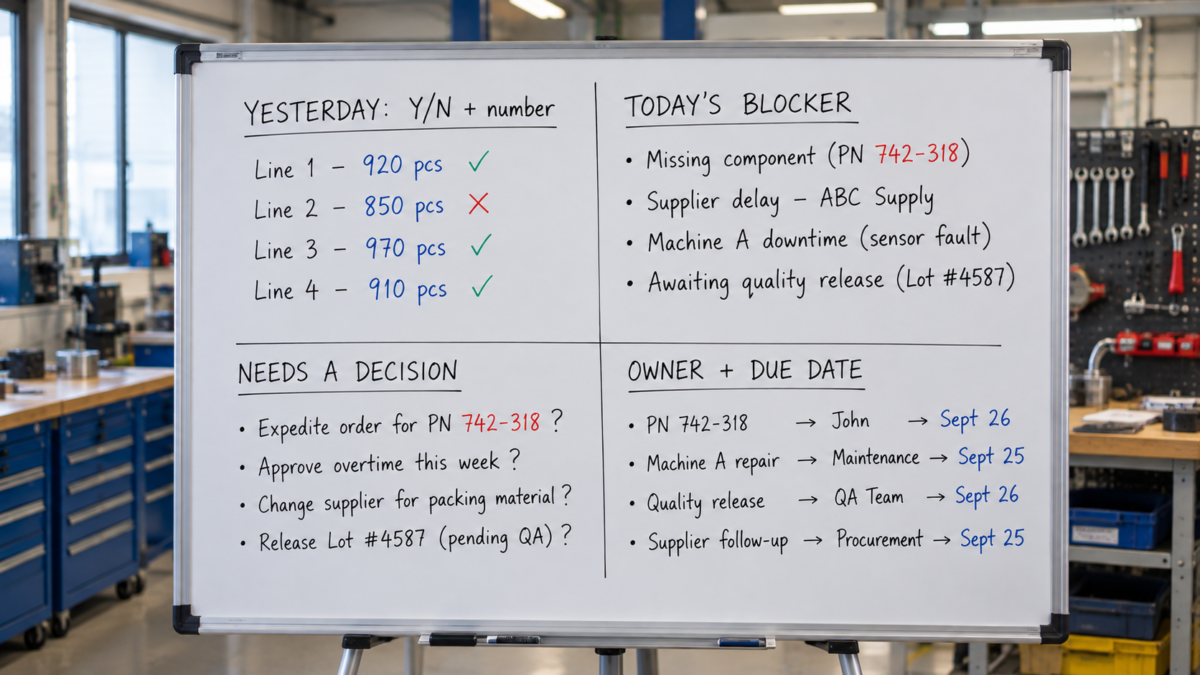
Forget the generic three questions. For a shop floor, four boxes, drawn once on a whiteboard with a marker, cover everything that actually needs to happen in 15 minutes:
- Yesterday’s result: a yes/no and a number. Did we hit the target, and what was it? Save the explanations for later. They’re what drag a meeting past 15 minutes.
- Today’s blocker: the single biggest thing in the way, in plain shop language. “The CNC is down,” not “operational constraint on machining capacity.” If there’s more than one, write the worst one. The rest can wait.
- Needs a decision: anything someone in the room has to decide today. “Do we pull someone from line 2 to cover this?” If there’s nothing, write “none.” An empty box looks like someone forgot to check.
- Owner + due date: who’s fixing it, and the exact date. Never “soon.” “John, fix the fixture, by Thursday.” On Thursday, everyone already knows whether it happened, and nobody has to chase John down to ask.
That’s the whole board. Four boxes, same order, every single day.
Here’s what it looks like running on a real shop floor:
How the 15 minutes actually runs
Everyone stands. Nobody pulls up a chair, and people who are standing don’t settle in for a long talk. One person owns the board, usually the supervisor or shift lead, and that person stays the same from week to week. Rotate it and nobody really owns it. They walk through the four boxes out loud, in the same order every time, so the meeting never turns into whoever talks the loudest.

If a topic needs more than two minutes of back-and-forth, it gets a name and a slot right after the meeting. Eight people shouldn’t stand there while two of them argue. Hold it at the same time every day, ideally first thing, before the shift gets pulled into firefighting. Do this for a month and you’ll notice the board was never the magic. Showing up at the same time every morning was.
A real example, two weeks in
Here’s what this looks like once it’s running. A small shop writes “supplier late” in the blocker box on a Monday. It happens again the following Monday. By the third Monday, it’s written in marker three times, always on a Monday. Nobody would have connected those dots from memory. On the board, in handwriting, you can’t miss it.
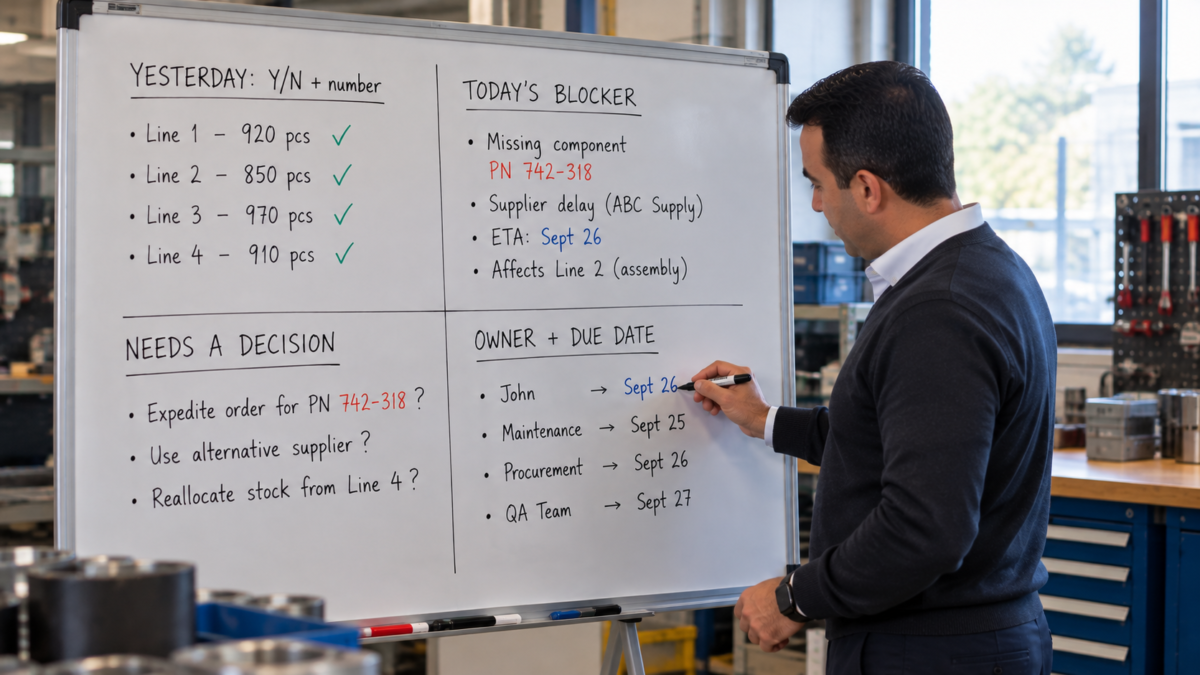
The same thing happens with equipment. Say a machine fails every time one specific operator runs the night shift. Before anyone blames the operator, look at the training and the shift handoff. The board just pointed you there. You didn’t need a login or a report in your inbox to see it. You walk past the board and you know where the shop stands in ten seconds, for the cost of a whiteboard and a few markers.
What to do when the blocker is too big to fix today
Sometimes what lands in the “today’s blocker” box is a real problem: a machine waiting three weeks for a part on backorder, or a supplier who needs a proper conversation. Fifteen minutes standing at a whiteboard won’t solve that, so don’t try.
Here’s the rule: if a blocker survives on the board for more than three days unchanged, it leaves the daily list. It becomes a standing item that its owner reports on in 30 seconds, outside the 15-minute window. Mark it with a small star or a different color so everyone can see at a glance that it’s being tracked. This is also where the whiteboard beats a mental to-do list. A problem that’s been open for 9 days is easy to forget in your head. In marker, on the wall, it gets more uncomfortable every morning.
Whiteboard vs. digital system: which one do you actually need right now
Every software vendor selling a daily-management dashboard will tell you that paper doesn’t scale. Eventually, they’re right. So the useful question is which one matches where your shop is today:
| Situation | Best fit |
|---|---|
| Single shift, single site, under ~25 people | Whiteboard. A dashboard adds a login step to a problem a marker already solves. |
| Multiple shifts handing off to each other | Whiteboard still works, but take a phone photo of the board at shift change so the next shift starts from where the last one left off. |
| Multiple sites, someone needs to see all of them at once | This is where a digital system starts earning its subscription, you genuinely can’t walk past four boards in four cities. |
| You want historical data for a compliance audit or ISO review | A digital log helps here, but you can also just photograph each day’s board and keep a folder, it costs nothing and satisfies most auditors. |
Most of the small shops I work with are solidly in the first two rows. What they’re missing is a habit. You can build one with a $5 marker, and nobody has to approve a purchase order first.
The mistakes that quietly kill this meeting
This format is simple, which makes it easy to drift away from. The three failure modes I see most often:
- Adding a fifth question. “How’s everyone feeling” or “any other business” feels harmless, but the moment you add it, the meeting creeps back toward 40 minutes, because there’s always something to add. Four boxes, no more.
- Letting it become a venting session. Four boxes, in order, nothing else. The instant it turns into open complaining, you’re back to the ramble you were trying to escape.
- Running it “whenever it’s convenient.” A daily meeting that moves around the schedule quietly stops happening within two weeks. Fixed time, every day. Skip that and the board won’t save you.
How to run it, step by step
- Draw the 4-box grid. One time, on a whiteboard, with a marker. Label the boxes: Yesterday, Today’s Blocker, Needs a Decision, Owner + Due Date.
- Fill in yesterday’s result. A yes/no and the number. No explanations yet.
- Write today’s biggest blocker. Plain shop language. If there’s more than one, write the worst one.
- Flag anything needing a decision. Something for someone in the room to decide right now. Write “none” if there’s nothing.
- Assign an owner and exact due date. Never “soon.”
- Stand up and run it. One person owns the board, walks through the four boxes out loud, in order, same time every day. Park anything over two minutes for right after.
Get the printable board template
If you’d rather not draw the grid from scratch, I put together a free printable version of this exact four-box layout, the same one shown in the video. Tape it up tomorrow morning and run it every day for two weeks before you judge it. One day won’t show you a pattern. Two weeks will.
Download the free Daily Board Template (PDF) →
When you’ll actually outgrow this
Once you’re running multiple shifts or multiple sites, tracking dozens of lines at once, this whiteboard won’t be enough. That’s a different stage and a different budget, and a real tool earns its cost there. But if you’re a small shop and the same problem keeps coming back without anyone knowing why, try this first. It costs a whiteboard and 15 minutes a day. Buy software when the board can’t keep up anymore.
Set up and run a daily standup for a small manufacturing team using a 4-box whiteboard layout, no software required
Total Time: 15 minutes
Step 1:
Draw the 4-box grid. One time, on a whiteboard, with a marker. Label the boxes: Yesterday, Today’s Blocker, Needs a Decision, Owner + Due Date.
Step 2:
Fill in yesterday’s result. A yes/no and the number. No explanations yet.
Step 3:
Write today’s biggest blocker. Plain shop language. If there’s more than one, write the worst one.
Step 4:
Flag anything needing a decision. Something for someone in the room to decide right now. Write “none” if there’s genuinely nothing.
Step 5:
Assign an owner and exact due date. Never “soon.”
Step 6:
Stand up and run it. One person owns the board, walks through the four boxes out loud, in order, same time every day. Park anything over two minutes for right after.
Frequently asked questions
How long should a daily standup meeting actually take?
15 minutes. If it regularly runs longer, someone is almost always trying to solve a problem during the meeting instead of giving it an owner and a date for later. The simplest way to keep it short: everyone stands.
What’s the difference between a daily standup and a tier 1 meeting?
Mostly vocabulary. “Daily standup” comes from software/agile teams, “tier 1 meeting” comes from lean manufacturing. Same idea: a short, structured, standing check-in, once a day, at the same level of the operation.
Who should run the meeting if the supervisor is out?
Name a backup in advance. Deciding on the spot, the morning someone is absent, rarely goes well. The backup should be someone who has watched the meeting run correctly a few times. Picking whoever is standing closest to the board that morning rarely works.
What if nobody has anything to put in a box?
Write it down anyway. “Yesterday: yes, no issues” and “Today: none” are real entries. Write them and keep the meeting. The moment a shop starts skipping meetings on quiet days, it starts skipping them on busy days too, and those are the days it matters most.
Can this work for an office team, not a factory floor?
Yes. Any team whose work you can see works fine: a warehouse, a lab, a print shop. It tends to work less well for fully remote teams, where a shared screen replaces the whiteboard anyway. That’s closer to the Slack-bot version other guides already cover well.
Do I need a dedicated whiteboard, or can I use a wall and sticky notes?
A whiteboard and a marker are the easiest to keep clean day to day, but a wall with four taped-off sections and sticky notes works just as well. Use whatever is easiest to keep clean. The four boxes are what count.
I’m Zouhair, founder of TRI Principles Institute. I work directly with small and mid-size manufacturers on operational excellence, from daily management routines like this one to full Lean and OEE programs, built to fit shops that don’t have a software budget for every problem. If you want a more structured diagnostic of where your operations stand, try the free Operational Excellence Assessment.
3 thoughts on “Daily Standup Meeting With a Whiteboard: Run It in 15 Minutes”