
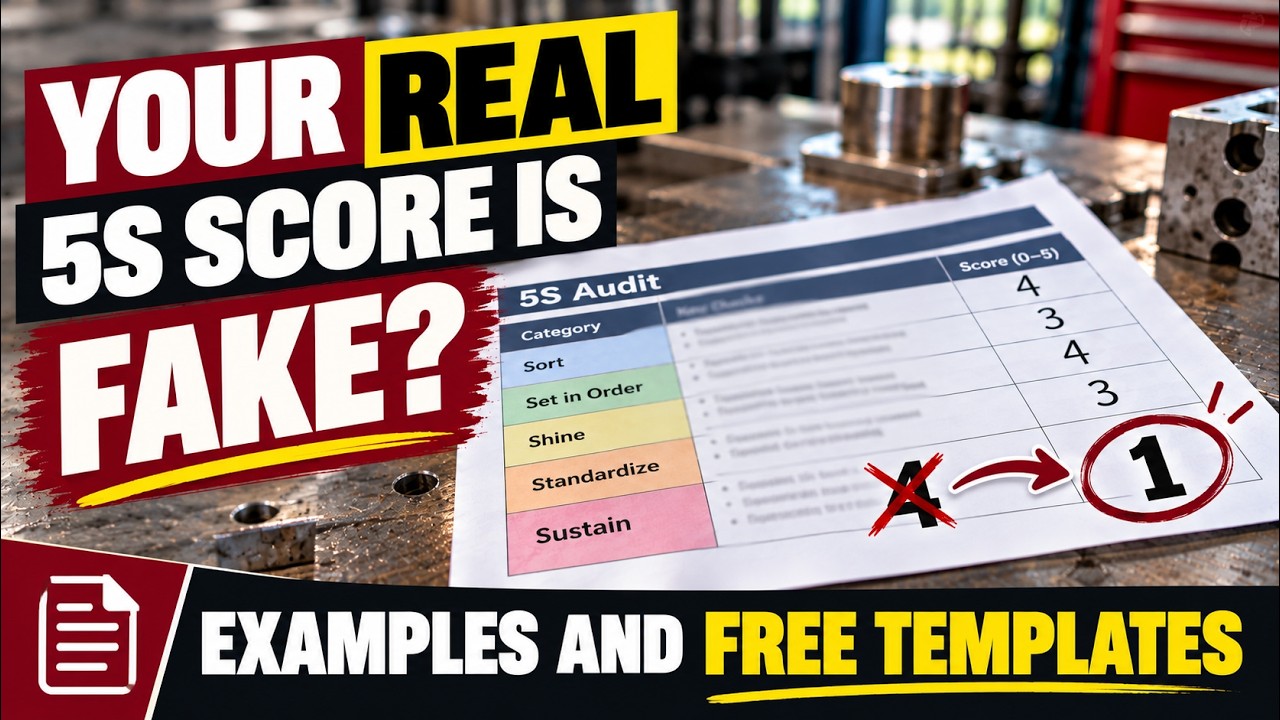
The bench scored a 4 on Sort and a 4 on Shine. Then someone asked one question, and Sustain dropped to a 1 right in front of the owner. That’s what a 5S audit is actually for: most templates show up blank, five categories and a score box next to each, and the first time a team fills one out, they either mark everything a 5 because the area got cleaned up for the audit, or everything a 2 because nothing feels finished. Neither version tells you what to fix next.
This guide walks through a real 5S audit, the way it plays out in a small shop: what gets scored high too fast, what gets missed, and how the numbers turn into one short list of actions. It continues the shop from our 5 Whys example, where splitting the deburr and inspection roles fixed a two-year-old bottleneck. This is the audit the team ran at that same bench, three weeks after the fix.
Table of Contents
The short version
5S is a method for organizing a work area so that anything out of place is visible at a glance: Sort, Set in Order, Shine, Standardize, Sustain. An audit scores each of the five against a simple scale, usually 1 to 5, so a team can see which one is actually weak instead of guessing. Here is the method in five lines:
- Sort: remove anything from the area that isn’t needed for today’s work.
- Set in Order: give everything that stays a marked, obvious place.
- Shine: clean the area, and use the cleaning to spot problems early.
- Standardize: write down what “in order” looks like, so anyone can check it.
- Sustain: keep it that way without someone chasing it every week.
The rest of this article shows the method applied to a real bench, the mistake that inflates a first audit score, and a one-page worksheet you can run your own audit with.
Where 5S comes from
5S traces back to the Toyota Production System, and the five Japanese terms (Seiri, Seiton, Seiso, Seiketsu, Shitsuke) were popularized in English by Hiroyuki Hirano’s writing on workplace organization. A place for everything makes a missing tool, a leaking valve, or a growing pile of waiting parts visible within seconds, instead of staying hidden until it causes a bigger problem.
Sustain is usually the category that decides whether 5S sticks. The first four categories can be done in an afternoon. Keeping them true six months later is the actual work.
Why a 5S audit beats a one-time cleanup
A cleanup day makes an area look good for a week. An audit gives the area a number, and a number can be tracked, compared, and improved on. Without a score, “the shop looks better” is an opinion nobody can act on. With a score, “Sustain dropped from 4 to 2 since last month” is a fact that points straight at what to fix.
A short 5S audit usually runs 15 to 20 minutes per area, and replaces “it’s cleaner now” with five numbers the team can track over time, the same way the daily standup board already tracks output and actions.
Before you start: three things that decide whether it works
1. Score what’s true today, not what was true after the cleanup
A freshly tidied bench during the audit tells you little about whether it stays tidy on its own. Score what’s normally true, not what’s true right now.
2. Use the same scale and the same checklist every time
If the scoring criteria shift between audits or between areas, the numbers stop being comparable, and the trend line becomes meaningless.
3. Walk the area with the person who works there
The operator knows which “out of place” items are actually used daily and which ones are leftover clutter. An audit done without them usually overscores Sort and underscores what the operator actually struggles with.
The worked example (illustrative)
This continues the shop from the 5 Whys example: the deburr and inspection roles had just been split after sitting combined for two years, and the daily board now flags a station’s wait time the first time it comes up twice in a week. Three weeks after the split, the owner and the quality lead ran the shop’s first 5S audit at that same bench, with the operator who runs it every day.
| Category | Score (1-5) | What they saw |
|---|---|---|
| Sort | 4 | Only current-job parts and tools at the bench. One box of obsolete fixtures from a discontinued part was still under the table, unused for over a year. |
| Set in Order | 3 | Hand tools had marked spots on a shadow board. The inspection stamp and certificate forms didn’t, they moved between three different drawers depending on who used them last. |
| Shine | 4 | The bench and floor were clean. Metal shavings still built up under the deburr tool by mid-afternoon, nobody had a fixed time to clear them. |
| Standardize | 2 | No written standard existed for what “ready for the next shift” looks like at this bench. The outgoing operator cleared the bench from memory, differently each time. |
| Sustain | 1 | This was the first audit ever run here. No recurring check, no owner assigned to keep the score up. |
5S Audit Score
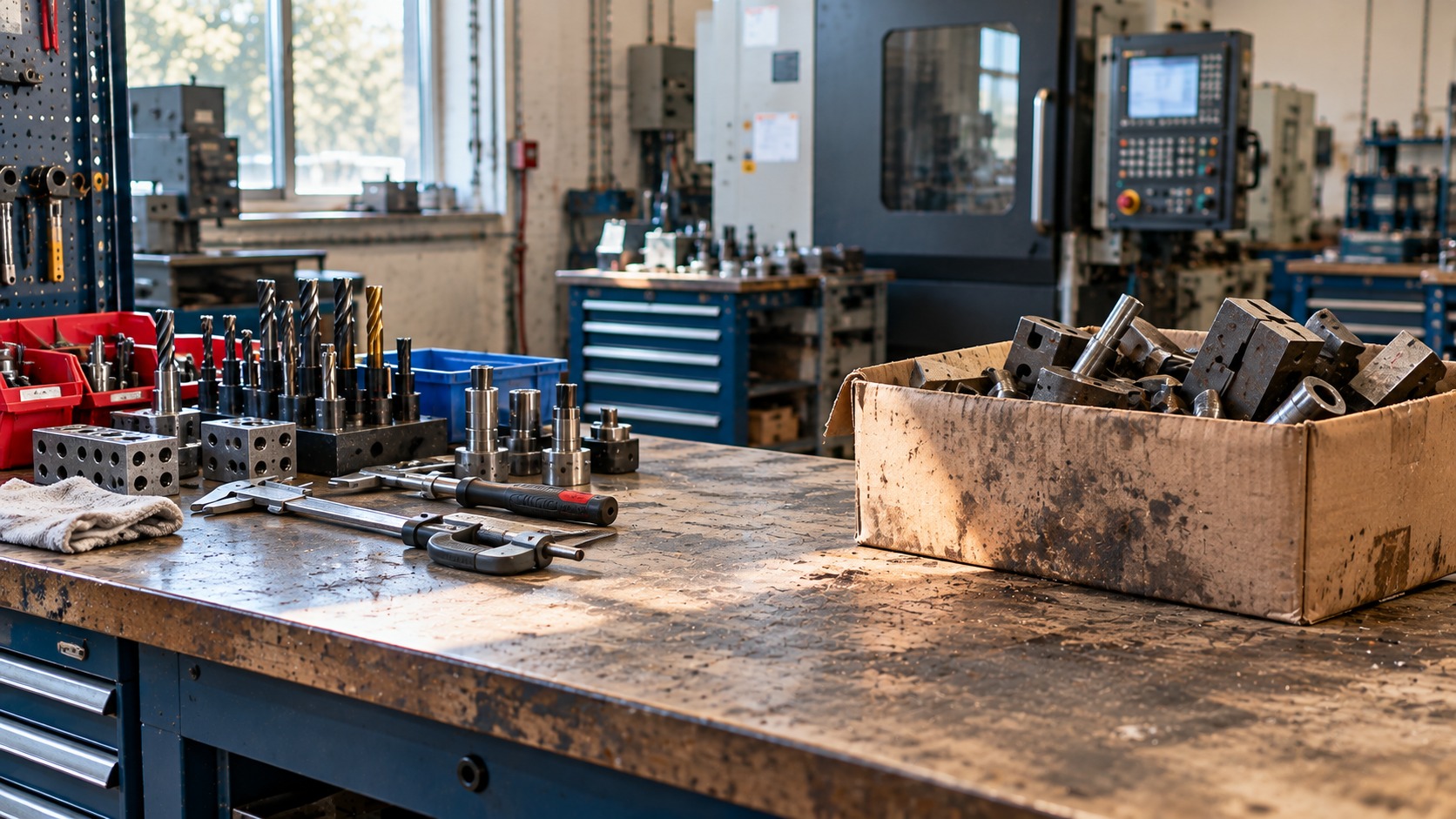
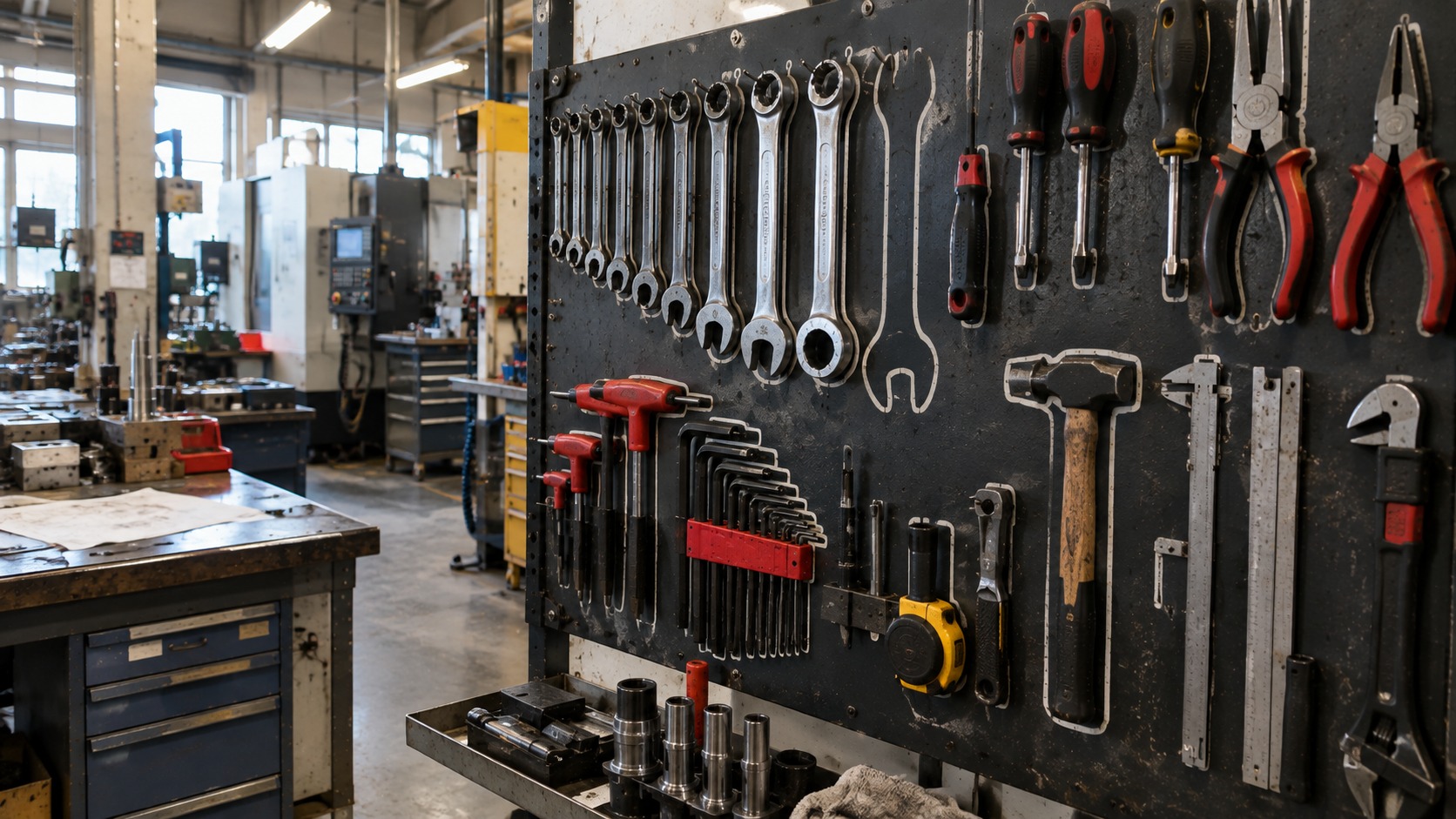



The bench looked good because it had just been reorganized after the role split, not because anything held it there. That’s the gap a one-time cleanup hides, and exactly the gap an audit is built to catch.
Three things came out of the audit. A red tag went on the box of obsolete fixtures that day, with a two-week hold before it leaves the floor for good. The inspection stamp and forms got one marked spot on the shadow board, so Set in Order stops depending on memory. And the quality lead wrote a one-page “end of shift” standard for the bench, the three things that must be true before it’s handed off, posted where the next operator sees it. The operator owned checking the standard daily for a month.
A mistake worth seeing in full
The team’s first pass at scoring this bench gave it a 4 or 5 across every category, because the area had just been cleaned up for the audit itself. That’s the most common way a first 5S audit lies: it measures the day of the audit, not the weeks before it. The score only became useful once someone asked “would this still look like this if nobody knew we were walking through today?” For Sustain, the honest answer was no, and the score dropped from a guessed 4 to an actual 1.
Common mistakes that inflate a 5S audit
Scoring the cleanup, not the habit. An area tidied an hour before the audit scores high on everything except what it should: whether it stays that way without being chased.
Treating 5S as a one-time project. A single 5S event with no audit afterward usually decays within a few months, because nothing measures whether it held.
Auditing without the operator. A supervisor walking the floor alone tends to score Sort generously and miss the daily friction points the operator actually deals with.
Comparing areas that used different criteria. If one area was scored strictly and another loosely, the comparison between them is worse than no comparison at all.
Writing vague actions. “Improve Standardize” is not something anyone can check next month. “Post the end-of-shift standard by Friday, quality lead” is.
5S audit worksheet (copy this)
One sheet, one area. Score what’s normally true, not what’s true right now.
| Area / station | ||
|---|---|---|
| Category | Score (1-5) | What you saw |
| Sort | ||
| Set in Order | ||
| Shine | ||
| Standardize | ||
| Sustain | ||
| Action | ||
| Owner and due date |
After the audit: turning scores into one experiment
A 5S audit ends with five numbers and a short list, not a finished area. Treat the actions that come out of it as something to check, not something to assume worked.
- Write the action with an owner and a date. “Post the end-of-shift standard, quality lead, by Friday” rather than “standardize the bench”.
- Post a visual standard at the station, a reference photo of what “ready” looks like for Sort, Set in Order, and Shine. Once that photo is up, scoring stops being a judgment call: it’s a 90-second yes-or-no comparison against the picture.
- Audit it again daily, not monthly. With the standard posted, the same five categories take about 90 seconds to re-score. Log the result on your daily management board, right next to safety, quality and delivery, the same place actions from the 5 Whys session are already tracked.
4. Flag anything under 3 to whoever runs the daily huddle. A score that drops and stays unreported is how 5S quietly stops being checked.
5. If Sustain doesn’t move, that’s information. It usually means no one actually owns keeping the score up, not that the standard was wrong.
How 5S compares to other tools
| Tool | Best for | Difference from 5S |
|---|---|---|
| 5 Whys | Finding why a specific problem happens. | Follows one chain of causes. 5S scores the physical state of an area, not a single incident. |
| Daily standup board | Tracking output, actions and wait time day to day. | Ongoing and short. 5S is a scored check of how an area is organized, 90 seconds a day once a visual standard is posted. |
| Visual management | Making abnormal conditions obvious at a glance. | 5S is one of the main ways a shop builds visual management into a physical space. |
| Kaizen event | A focused, one-time improvement push on a specific problem. | A kaizen event can include a 5S pass, but 5S on its own is meant to repeat, not to be a one-time project. |
Where to go from here
This audit followed directly from the 5 Whys example at the same bench. If the area you want to audit hasn’t had a root-cause session yet, that’s usually the better place to start, since 5S organizes a space but doesn’t explain why it got disorganized in the first place.
Once you have a baseline score, track it the same place your team already checks every day: the daily standup board. If you’re not sure which area to audit first, the free Operational Excellence Assessment is a few minutes of questions that show where to look.
The worksheet above is the same five categories you’d use for a first, unhurried audit, before any visual standard is posted. Once a reference photo is up at each station, scoring becomes a fast yes-or-no comparison, and the same sheet works as a daily check instead of a one-time pass. For a ready-made version of that daily routine, our free 5S Daily Audit Kit uses a 20-point checklist with its own scoring scale.
Get the free 5S Audit Worksheet (PDF) →A 5S audit scores a work area across five categories so a team can see which one is actually weak, instead of guessing. Here’s how to run one.
Total Time: 5 minutes
Sort
Remove anything from the area that isn’t needed for today’s work. Example: a box of unused parts sitting under the bench for a year should be red-tagged.
Set in Order
Give everything that stays a marked, obvious place, like a shadow board outline for each tool.
Shine
Clean the area, and use the cleaning to catch problems early, like metal shavings building up by mid-shift.
Standardize
Write down what “in order” looks like, and post a reference photo at the station so anyone can check it.
Sustain
Re-check daily using the posted standard, log the score on the daily board, and flag anything under 3.
Frequently asked questions
What is a 5S audit?
It’s a scored walk-through of a work area across five categories, Sort, Set in Order, Shine, Standardize and Sustain, used to track whether an area stays organized over time instead of just looking good on cleanup day.
How is a 5S audit scored?
Each of the five categories gets its own score, usually on a 1-to-5 scale, judged against a written standard rather than a gut feeling. Some shops also average the five into one overall number, but the five separate scores matter more: they show which category is weak, which an average hides.
Who should perform a 5S audit?
Whoever runs the area, plus someone from outside it. The operator catches what’s actually used day to day; a second set of eyes, a supervisor or quality lead, catches what’s become normal to the operator but wouldn’t pass a fresh look.
How often should a 5S audit be done?
Daily, once the area has a posted visual standard, a reference photo at the station showing what “ready” looks like. With that in place, scoring the five categories is a 90-second yes-or-no comparison, logged on the daily management board next to safety, quality and delivery, with anything under 3 flagged to whoever runs the huddle. Before the standard exists, run the full unhurried version first to find out what that standard should be.
What is a red tag area in a 5S audit example?
A red tag is a flag put on anything in the area nobody can confirm is needed: an unused fixture, an old batch of parts, a tool with no marked home. Tagged items go to a holding area for a set number of days; if nobody claims them, they get removed. It’s how Sort gets decided by evidence instead of opinion.
Written by Zouhair Lahia, founder of TRI Principles Institute. Zouhair is an Operational Excellence and Lean transformation leader with over 20 years of experience across aerospace, automotive and manufacturing operations, a Lean Six Sigma Black Belt and CPIM-certified professional. He works with small and mid-size manufacturers on daily management, measurement systems and operational routines that hold up on a real shop floor. Last reviewed: October 2026.
Sources and further reading: Toyota Motor Corporation, Toyota Production System. The shop in the worked example is the same illustrative case used in our gemba walk and 5 Whys examples, not a client.