
Most 5 Whys articles give you a clean example with five tidy lines, each one leading straight to the next. The real exercise does not work that way. The team gets three questions in, someone says “the operator was behind schedule”, everyone nods, and the session ends at a symptom dressed up as a cause.
This guide walks through a full 5 Whys example session the way it actually happens in a small shop: the wrong turns, the question that reopens the chain, and the cause nobody expected. It continues the shop from our gemba walk example, where a 20-minute walk found parts piling up at the deburr bench. This is what happened when the owner sat down to find out why.
Table of Contents
The short version
The 5 Whys is a method for finding the cause of a problem by asking “why” repeatedly, each answer becoming the next question, until you reach something you can actually fix. Five is a guide: some chains stop at three, others need seven. Here is the method in five lines:
- Write the problem down as one fact, not a feeling.
- Ask why it happens, and write the answer as a fact too.
- Ask why that answer is true, and keep going.
- Stop when the next answer is something a person in the room can act on.
- Check the chain backwards before you commit to it: does each “why” really explain the one above it?
The rest of this article shows the method applied to a real bottleneck, the mistakes that send a 5 Whys off track, and a one-page worksheet you can run your own session with.
Where the 5 Whys comes from
The method is usually credited to Sakichi Toyoda, founder of the company that became Toyota, and it became part of the Toyota Production System under Taiichi Ohno. The idea behind it is older than the name: a problem you can see is rarely the problem you need to fix, and the only way to tell the difference is to keep asking.
Toyota’s own training material treats the number as a habit more than a target: ask “why” as many times as it takes to reach a cause the team can act on, and stop drilling once you are explaining something nobody in the room can change, like “the economy” or “people make mistakes”.
Why a 5 Whys session beats a quick fix in a small shop
In a small shop, the fastest fix is usually to patch the symptom. The bench is backed up, so someone gets pulled from another job for the afternoon. The certificate is late, so the owner signs it after hours. Both make the problem disappear for a day and guarantee it comes back next week, because nothing about the cause has changed.
A short 5 Whys session costs 15 to 20 minutes and turns a vague complaint, “we’re always behind on Fridays”, into one sentence the team can act on. It also does something a quick fix cannot: it usually surfaces a cause nobody blamed at the start, which is often where the real opportunity is.
Before you start: four things that decide whether it works
1. Write the problem as one fact
“The shop is disorganised” cannot be chased with “why”. “Nine trays were waiting at the deburr bench at 10:40 on Tuesday” can. If your starting sentence has an opinion in it, rewrite it until it is something two people would agree happened.
2. Get the right people in the room
Include the person who does the work, not only the person who manages it. The operator at the bench knows things about the job that nobody else in the room does, and a 5 Whys run without them usually drifts toward blaming them.
3. Set the one rule that matters
Say it before you start: this is about the process, not the person. “The operator is slow” is not an answer, it is a stop sign. If that answer comes up, the next question is “why is the process set up so that speed depends on one person”, and you keep going.
4. Write every answer down as you go
A chain that only exists in conversation gets edited by memory within a day. Five short lines on paper, in the room, while you are asking them.
The worked 5 Whys example (illustrative)
This continues the shop from the gemba walk example: 18 people, machined brackets and housings. The walk found nine trays waiting at the deburr bench, run by the one person who also handled final inspection and certificates. The action from that walk was to split the two jobs. Before doing that, the owner ran a 5 Whys with the person at the bench and the quality lead, to make sure splitting the jobs was actually the fix and not a guess dressed up as one.
Problem: Nine trays of parts were waiting at the deburr bench on Tuesday at 10:40, and this pattern repeats most Thursdays, which is why Friday orders ship late.
| Step | Why | Note |
|---|---|---|
| Why 1 | Why were parts waiting at the bench? Because the person who runs it also does final inspection, and stops deburring whenever a batch needs a certificate. | Matches what the walk already found. |
| Why 2 | Why does one person do both jobs? Because when the deburr step was added two years ago, it was folded into the inspection role, and nobody split it back out. | This is further back than the team expected on the first try. |
| Why 3 | Why wasn’t it split out later, once the backlog started? Because nobody was tracking how long parts waited at that bench, so the backlog grew slowly enough that it never looked urgent. | The team’s first instinct was to stop at Why 2 and say “split the job”. This question is what moved it further. |
| Why 4 | Why isn’t anyone tracking wait time at that bench? Because the daily board tracks output at the end of the line, not time at individual stations. | Now pointing at the daily routine, not the bench itself. |
| Why 5 | Why does the daily board only track the end of the line? Because it was built to answer “did we ship today”, and nobody has revisited it since the shop grew from 6 to 18 people. | This is where the team stopped: a fact everyone in the room could confirm, and something the owner could act on directly. |
Read the difference between Why 1 and Why 5. The first answer blames a bottleneck everyone could already see. The fifth answer explains why that bottleneck was invisible for as long as it was, and it is the one the team could actually fix.
Two actions came out of the session, not one. Split the deburr and inspection roles, which was already planned from the walk. And add one line to the daily board: a station’s wait time gets flagged the first time it is mentioned twice in a week, so the next bottleneck gets caught before it takes two years to notice. The quality lead owned the second action, due the following Monday.
A mistake worth seeing in full
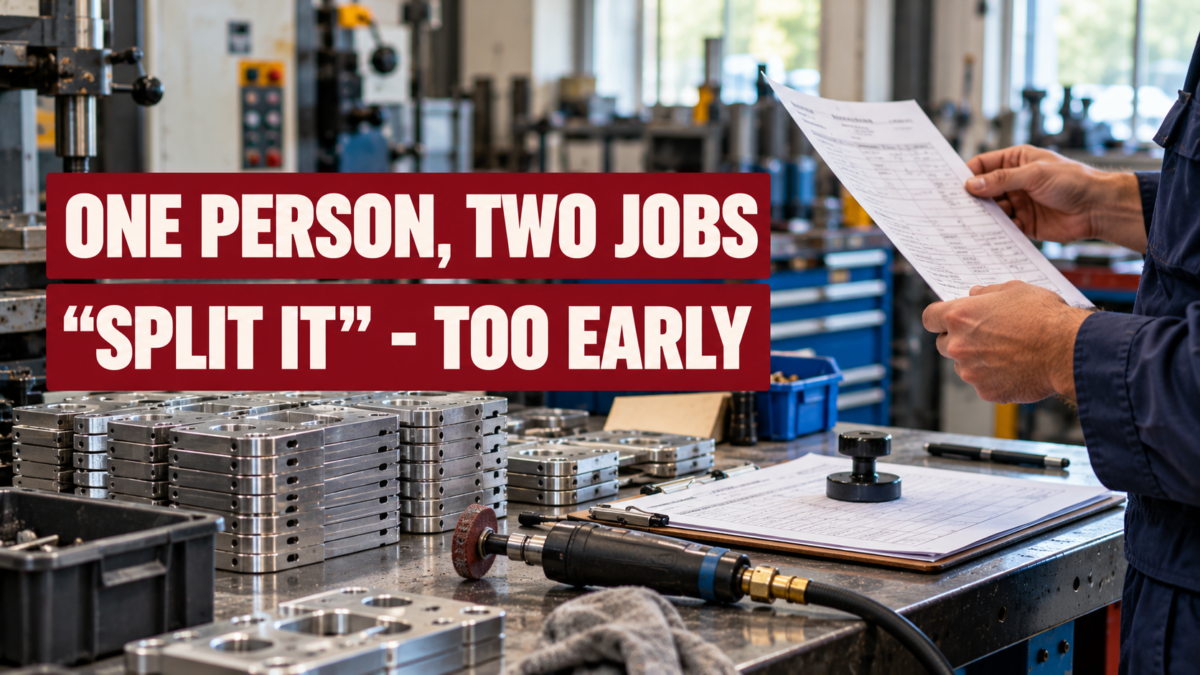
The team’s first pass at this session stopped after two whys, at “the operator also does inspection, so split the job.” That is a real fix, and it is also where most 5 Whys sessions in a small shop quietly end, because the second answer already sounds like a solution. The only reason this one went further is that someone in the room asked “why has nobody split it already, if the backlog has been building for months.” That single extra question is what turned a bench-level fix into a daily-board fix that prevents the next bench from doing the same thing.
Common mistakes that stop a 5 Whys early
Stopping at a person. “The operator forgot” or “someone should have caught this” ends the chain at a place nobody can act on twice. Ask why the process depended on one person remembering.
Chasing only the first idea. The first answer that sounds right is not always the one worth following. A team that agrees too quickly on Why 2 has usually stopped a step too early, the way it nearly did here.
Treating it as a blame exercise. If the person closest to the problem is in the room and feels like a suspect, the answers get shorter and vaguer with every question. State the rule again if the tone shifts.
Running one chain when there were two causes. Some problems have more than one path. If the group splits on an answer, write both branches down and follow each one, rather than forcing a single line.
Skipping the evidence check. Before committing to the final cause, read the chain from the bottom up: does Why 5 really explain Why 4, does Why 4 really explain Why 3? If a link feels like a guess, go back and check it on the floor before you act on it.
5 Whys worksheet (copy this)
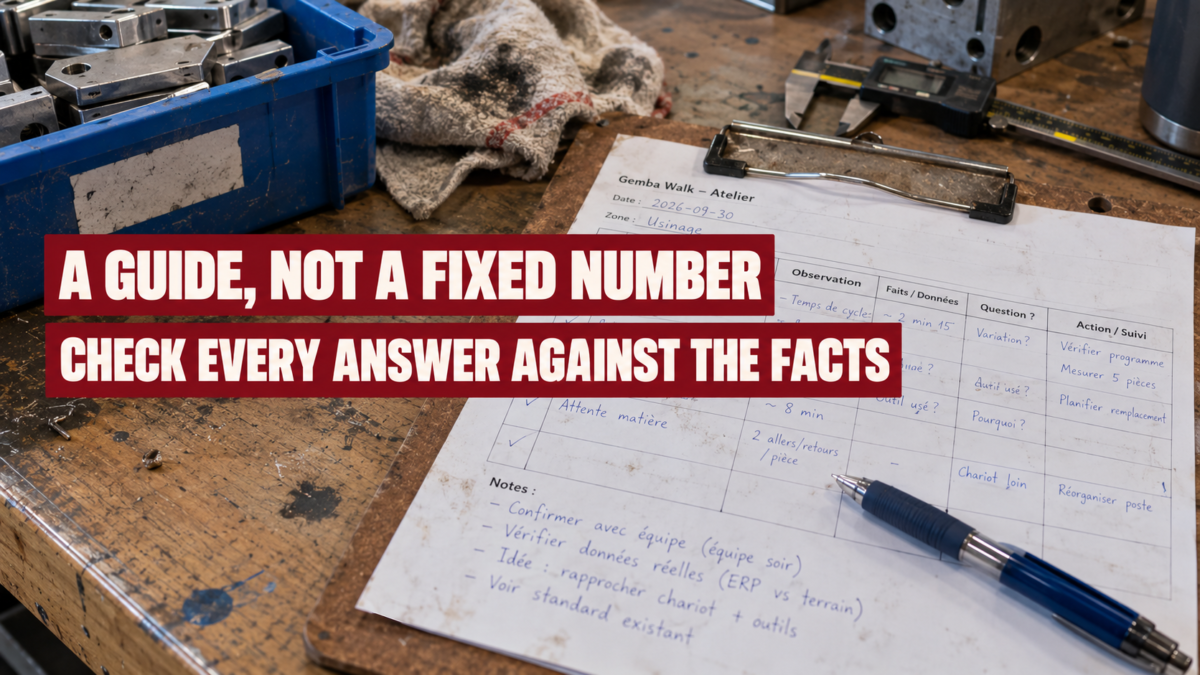
One sheet, one problem. Write the facts, not the first thing that comes to mind.
| Problem (one fact) | ||
|---|---|---|
| Step | Why | Checked against the evidence? |
| Why 1 | ||
| Why 2 | ||
| Why 3 | ||
| Why 4 | ||
| Why 5 | ||
| Action | ||
| Owner and due date | ||
Rather watch than read? The video below runs through this same bottleneck, from the first “why” to the action on the board.
After the session: turning a cause into one experiment
A 5 Whys session ends with a sentence, not a finished fix. Treat the action that comes out of it as something to test, not something to assume will work.
- Write the action with an owner and a date. “Flag a station the second time it’s mentioned in a week, quality lead, starting Monday” rather than “track bottlenecks better”.
- Put it on the daily board, the same place the daily standup already tracks actions from the gemba walk.
- Set a date to check whether it worked. Two to four weeks is usually enough to see whether the same bottleneck shows up again.
- If it didn’t work, that’s information, not failure. It usually means the chain stopped one step too early, and the next session picks up from Why 5 instead of starting over.
How 5 Whys compares to other tools
| Tool | Best for | Difference from 5 Whys |
|---|---|---|
| Fishbone diagram | Problems with several possible cause categories (people, method, machine, material). | Maps several branches at once. 5 Whys follows one chain deep. Many teams use a fishbone first to pick which branch to chase with 5 Whys. |
| Pareto chart | Deciding which problem to work on first, out of several. | Ranks problems by frequency or cost. It tells you where to point the 5 Whys, not how to run it. |
| A3 problem solving | Larger problems that need a written report and management sign-off. | A full one-page document with background, analysis, countermeasures and follow-up. A 5 Whys session is usually one section inside it. |
| Fault tree analysis | Complex equipment failures with multiple interacting causes. | Built for engineering teams with failure data. Heavier than most small shops need for a day-to-day bottleneck. |
Where to go from here
This session started from what a gemba walk found on the floor. If you haven’t run one yet, that is usually the faster way to find your first real problem to ask “why” about, rather than guessing at one from the office.
Once you have an action and an owner, write it where your team already checks every day: the daily standup board is usually that place, and it is where the gemba walk’s actions were already being tracked. If you are not sure which bottleneck to point your next 5 Whys at, the free Operational Excellence Assessment is a few minutes of questions that show where to look first.
Frequently asked questions
What is the 5 Whys technique?
It is a method for finding the cause of a problem by asking “why” repeatedly, using each answer to form the next question, until the chain reaches a cause someone can act on. It was developed at Toyota and is used across lean manufacturing and quality improvement.
What is an example of the 5 Whys?
In this article, the problem is parts waiting at a deburr bench. The chain runs from “one person covers two jobs” through “nobody tracks wait time at that station” to the root cause: the daily board only tracked output, not station-level delays, so the backlog went unnoticed for months.
How many whys should you ask?
Five is a guide, not a fixed number. Some problems reach an actionable cause in three questions, others need six or seven. Stop asking “why” once the answer is something a specific person can act on, and keep going if the answer is still a general statement nobody in the room can change.
What is the biggest mistake people make with the 5 Whys?
Stopping too early, usually at an answer that blames a person rather than explaining the process. “The operator forgot” or “someone should have checked” ends the chain at a place that cannot be fixed twice. The fix is to ask why the process depended on that person remembering in the first place.
Is the 5 Whys the same as root cause analysis?
The 5 Whys is one method within root cause analysis, not the whole field. Root cause analysis also includes tools like fishbone diagrams and fault tree analysis, which are often better suited to problems with several interacting causes rather than one chain.
Written by Zouhair Lahia, founder of TRI Principles Institute. Zouhair is an Operational Excellence and Lean transformation leader with over 20 years of experience across aerospace, automotive and manufacturing operations, a Lean Six Sigma Black Belt and CPIM-certified professional. He works with small and mid-size manufacturers on daily management, measurement systems and operational routines that hold up on a real shop floor. Last reviewed: October 2026.
Sources and further reading: Toyota Motor Corporation, Toyota Production System. The shop in the worked example is the same illustrative case used in our gemba walk example, not a client.
1 thought on “5 Whys Example: Finding the Real Cause of a Late Order in a Small Shop”