
Most gemba walk articles give you a definition, a seven-category checklist and a screenshot of a software dashboard. Then Monday morning arrives. You walk through your own shop with a clipboard, you have no idea what you are supposed to be looking at, and your operators wait politely for you to leave.
This guide is written for the person who runs a shop of 2 to 50 people, with no lean department, no software and about 20 minutes to spare. It shows the walk itself: the route, what to say at each stop, what to write down and what to do with the notes afterwards. It draws on lean work on factory floors in aerospace, automotive and general manufacturing.
Rather watch than read? The video below follows a full 20-minute gemba walk through a small shop, stop by stop, from the first question to the notes sheet filled in at the end. The shop and the people are made up, the method is the one in this guide.
Table of Contents
The short version
A gemba walk is a planned visit to the place where the work happens, made to watch the process and to ask the people doing the work some questions. Done well, it replaces a pile of reports with something you saw with your own eyes. Here is the whole method in six lines:
- Pick one focus for the walk.
- Walk the same route at the same time every week.
- Watch for two minutes before you say anything.
- Ask open questions about the work, never about the person.
- Write down facts: what, where, when, how many.
- Pick at most three actions, and tell the team what happened to them within a week.
The rest of this article explains each step, walks through a full example and lists the mistakes that make a gemba walk useless.
Prefer to start with a printable version? The notes sheet you will use on the walk fits on one page:
Download the free Gemba Walk Notes Sheet (PDF)The pocket guide is the companion page: the six steps, the 20-minute route, the questions and the follow-up on one page. Print both and keep them on your clipboard.
What “gemba” means and where the walk comes from
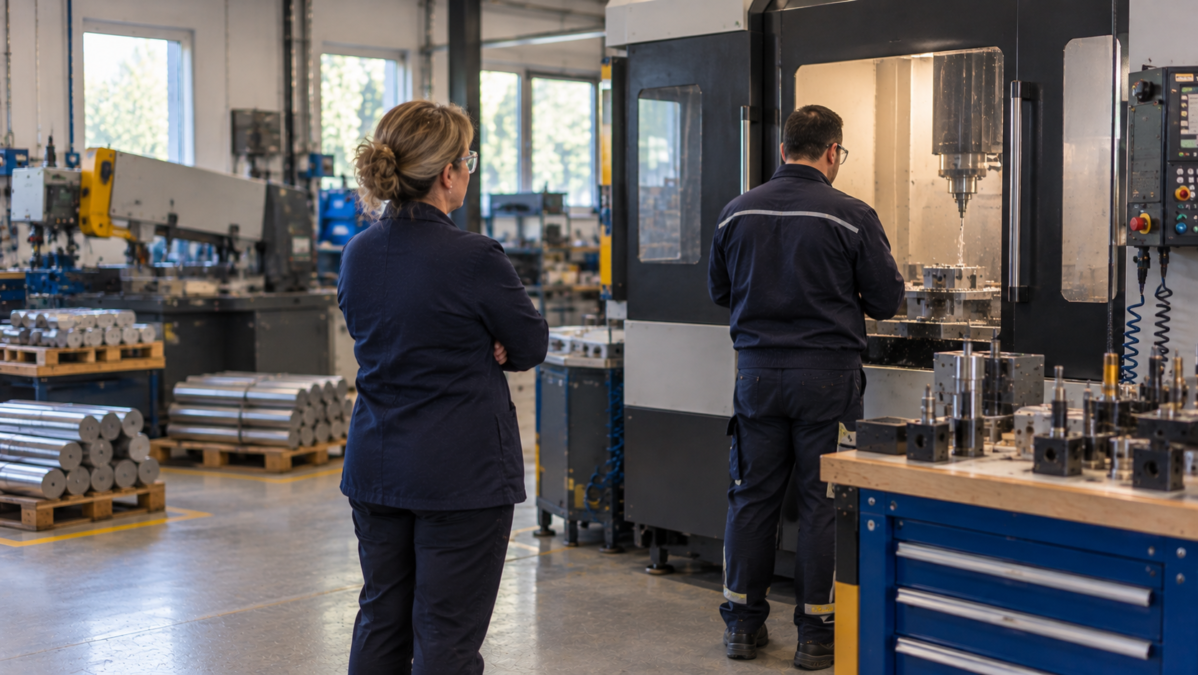
Gemba (現場) is Japanese for “the actual place”. In a factory it is the floor, in a hospital the ward, in a restaurant the kitchen. The Lean Enterprise Institute defines it as the place where value is created, and pairs it with genchi genbutsu, “go and see for yourself”. The idea is old and simple: you cannot understand a process from a desk.
The story most often told about Taiichi Ohno, the Toyota engineer behind the Toyota Production System, is that he drew a chalk circle on the floor, asked a young engineer to stand inside it and watch the line, and came back hours later to ask what he had seen. Whether or not every detail is accurate, the lesson holds. Watching one spot long enough shows you things that no report contains.
The modern “gemba walk” is a lighter, scheduled version of that habit. A manager leaves the office, visits the work on a regular rhythm, and uses what they see to support the people doing the job.
Why a walk beats a report in a small shop
In a small shop, the owner often hears about problems late and in summary form. “We were behind on the Henderson order” tells you the result. It does not tell you that the parts sat for a day and a half at the deburr bench because the one person who runs it was also covering inspection.
A walk also exposes what lean practitioners call the hidden factory: the rework, the workarounds and the extra handling that nobody records because everyone has learned to live with them. An operator who bends a bracket back into shape before it goes to the next station will never put that on a report. You will see it in 30 seconds if you are standing at the right place.
And there is a people effect. When the person who signs the purchase orders spends 20 minutes a week at the machines, asking how the work is going and then fixing something that was mentioned, the shop learns that speaking up leads to results. That does more for engagement than most posters on the wall.
Before you walk: five decisions that take ten minutes
1. Pick one focus
A walk without a focus becomes a tour. Choose one question, for example:
- Why do orders leave late on Fridays?
- Where does material wait the longest?
- Which machine stops most often during the shift?
- What makes the first part of the day slow to start?
You can change the focus next week. Within a single walk, stick to one.
2. Fix the day, the time and the route
Walk the same slot every week, for instance Tuesday at 10:30, and follow the product from the door where raw material arrives to the dock where it ships. Following the flow keeps you from jumping between departments and helps you see where work waits.
3. Tell people why you are coming
Say it once, in plain words, at the daily board or in a short team talk: “Every Tuesday I will walk the shop for about 20 minutes to see how the work flows. I am looking at the process, not at individuals. If something you tell me can be fixed, I will tell you what happened.” Then keep that promise. The daily whiteboard meeting is the natural place to report back.
4. Bring the right things
- A printed notes sheet and a pen (the template is further down).
- Your safety gear for the areas you will enter.
- Last week’s notes, so you can check what changed.
Leave the phone in your pocket. If you want a photo, ask first and explain what it is for.
5. Decide what you will not do
You will not solve problems at the machine, give instructions, criticise a person or take a decision on the spot. Write that on the top of your notes sheet if it helps. It is the rule that breaks most often.
A 20-minute walk, minute by minute
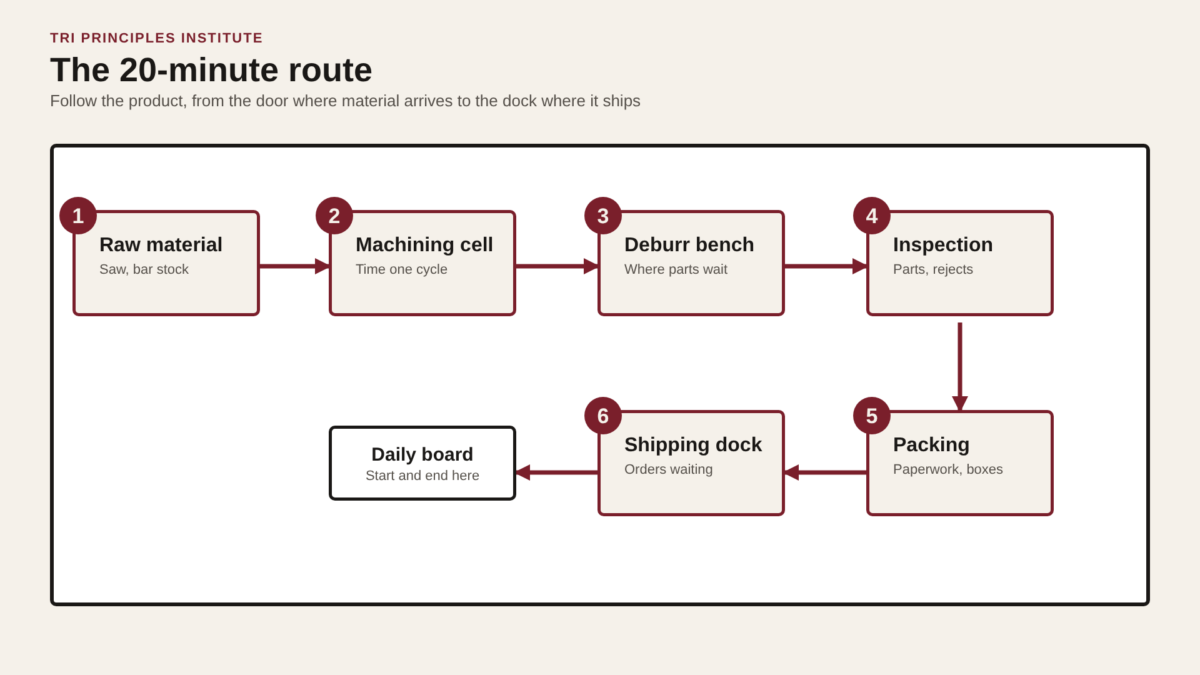
This is the route and rhythm I suggest for a shop with one building and one production flow. Adapt the stops to your layout.
| Minutes | Where | What to look at | What to ask |
|---|---|---|---|
| 0 to 3 | At the daily board | Yesterday’s result, today’s blocker, open actions from last walk. | Nothing yet. Read the board and set the focus for the walk. |
| 3 to 6 | Receiving and raw material | Is material where it should be? Is anything waiting, mislabelled or blocking an aisle? | “When material arrives late, what do you do?” |
| 6 to 10 | First machine or cell | Time one cycle. Count parts waiting before and after. Watch the operator’s hands and footsteps. | “What slows you down most during a shift?” |
| 10 to 14 | Middle of the flow (the stop with the most parts waiting) | Piles of parts, trays, carts. Rework. Anyone waiting for a tool, a drawing or a person. | “What do you do when this fills up?” |
| 14 to 17 | Inspection and packing | How parts are checked, how rejects are handled, how long a finished order waits before it ships. | “What problems do you find here that started somewhere else?” |
| 17 to 20 | Shipping dock, then back to the board | Orders waiting, missing paperwork, packaging problems. | “What would you change first if it were your decision?” |
Spend about two minutes at each stop. Stand where the work happens, keep your hands visible and out of your pockets, and let the person do the job while you watch. The first minute is for looking, the second is for asking one or two questions.
A worked example (illustrative)
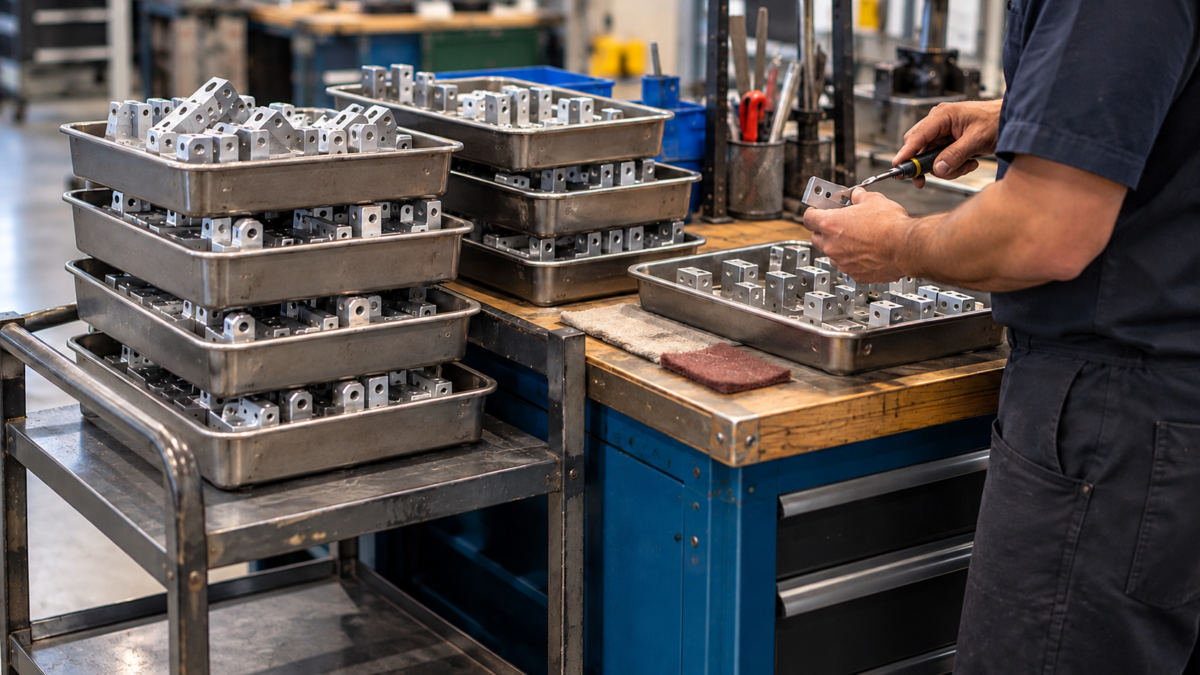
The example below is illustrative. It is built from the kind of situations small shops run into, and the numbers are examples chosen to show how to write notes, not results from a named client.
Take a shop of 18 people that makes machined brackets and housings. The owner has one problem on her mind: orders keep leaving late on Fridays, even though the machines look busy all week. She sets the focus, “Why do orders leave late on Fridays?”, and walks on Tuesday at 10:30.
| Stop | What she saw | What she asked and heard | Next step |
|---|---|---|---|
| Raw material | Two pallets of cut bar waiting near the saw. No problem seen. | “When do you cut for the week?” On Monday morning, for the whole week. | None. |
| Machining cell | One cycle timed at 6 min 10 s against a routing time of 6 min. Machine ran without stops during the 4 minutes she watched. | “What slows you down?” Waiting for the forklift to bring bar stock around 11:00. | Note it. Low priority. |
| Deburr bench | 9 trays of parts waiting. One person at the bench, who also does final inspection. | “What do you do when this fills up?” “I stop deburring and inspect, then go back. It is the same every Thursday.” | Look at the queue again on Thursday. |
| Inspection | A rack of finished parts waiting for a certificate. The person inspecting is the same one from the deburr bench. | “What problems do you find here?” “Burrs I could not reach earlier, but I run out of time to flag them.” | Raise at the daily board. |
| Shipping | 4 orders packed and waiting for paperwork. | “What would you change first?” “Have someone else do the certificates.” | Owner to decide who. |
Look at what she did not do. She did not blame the deburr bench for being slow. Her notes show one person doing two jobs at a single bench. She did not ask anyone to work faster. She wrote down what she saw, the number of trays, the cycle time and what was said.
On Wednesday morning she picks two actions and writes them on the daily board: move the certificate step to a second person (owner: the quality lead, due Friday), and check the deburr queue on Thursday afternoon to confirm the pattern. At the Wednesday meeting she tells the person at the bench what she will change. On the next walk, she looks at the same bench first.
That is the full cycle: see, ask, write, decide, tell, check. The walk itself took 20 minutes. The results came from the 10 minutes of follow-up.
Questions to ask on a gemba walk
Most competitor articles list a long checklist. A long list is hard to use on the floor, so here are the questions grouped by when they work best. Pick two or three per stop, not all of them.
To open the conversation
- How is the job going today?
- What are you working on right now, and what comes next?
- How long have you been on this machine?
About the work
- Can you show me how you do this step?
- What do you check before you start?
- How do you know when a part is good?
- What do you do if the drawing or instructions do not match what you see?
About problems
- What slows you down the most?
- What do you do when this happens?
- When did this last go wrong, and what did you do?
- Is there something you do every day that you think should not be needed?
About support
- What would make this job easier?
- Do you have what you need: tools, material, information, help?
- Who do you call when something stops, and how long until they come?
To close
- If it were your decision, what would you change first?
- Is there anything I should have asked and did not?
Questions to avoid
Some questions sound curious and land as accusations. “Why didn’t you do it the standard way?” and “Who set this up like that?” make the person defend themselves, and the conversation ends. Replace them with questions about the situation: “What makes this way easier?” and “How did this layout come about?”
What to look for with your own eyes
The classic list is the seven wastes, extended by an eighth, unused talent. In a small shop they show up in ordinary ways.
| Waste | What it looks like in a small shop |
|---|---|
| Transport | Parts carried across the building between two operations that could sit closer. |
| Inventory | Trays and carts piling up in front of one station. |
| Motion | Operators walking to fetch tools, gauges or drawings several times per shift. |
| Waiting | People or machines idle for the forklift, an inspector, a decision or a part. |
| Overproduction | Running a batch larger than the order needs, then storing the rest. |
| Over-processing | Polishing or checking beyond what the customer asked for. |
| Defects | Rework benches, scrap bins, parts bent back into shape. |
| Unused talent | Operators who see the problem and have nobody to tell. |
Add one more item that has nothing to do with lean theory: anything unsafe. A blocked exit, a missing guard or an extension cord across an aisle gets written down and fixed that day, whatever the focus of the walk was. For a wider view of finding and fixing hazards in a small business, OSHA publishes a free safety management guide built for small and medium-sized employers.
If the stops and waiting you see on the floor are the problem, you can put a number on them. Our guide to how to calculate OEE shows how short stops and slow cycles turn into a single figure you can track week to week.
The notes sheet (copy this)
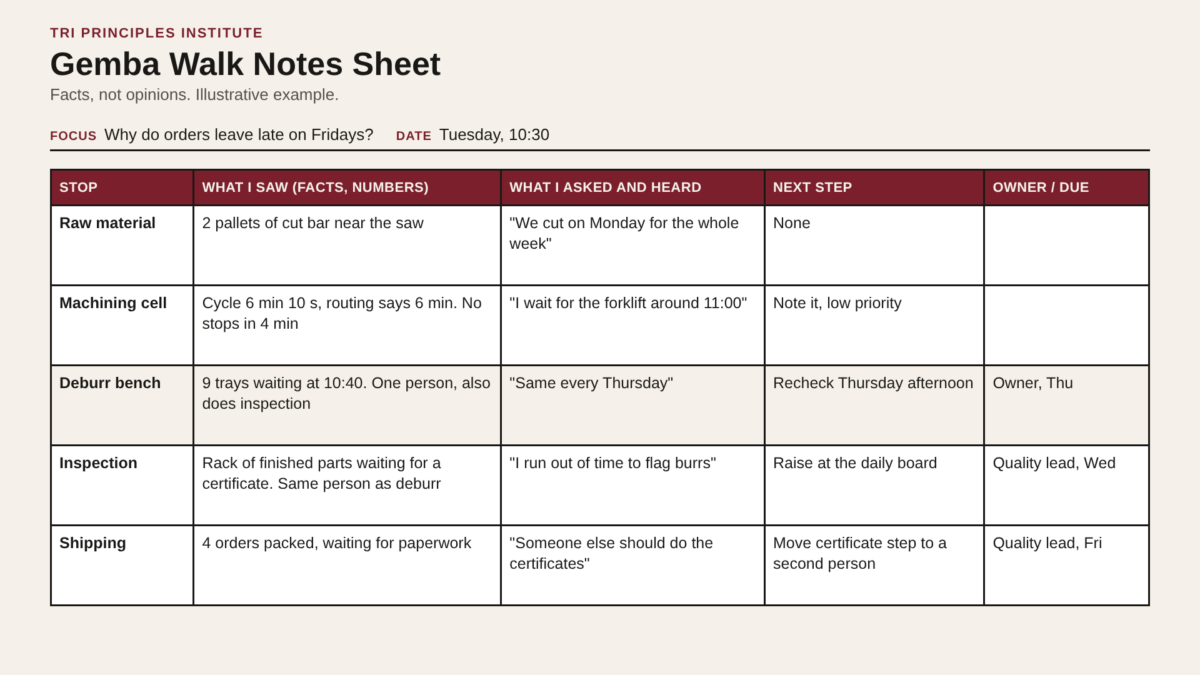
Paper works. Print this table, or draw it on a clipboard, and fill it in as you walk.
| Stop | Time | What I saw (facts, numbers) | What I asked and heard | Next step | Owner | Due |
|---|---|---|---|---|---|---|
The pocket guide is the companion page: the six steps, the 20-minute route, the questions and the follow-up on one page. Print both and keep them on your clipboard.
One rule makes this sheet useful: write facts, not conclusions. “9 trays waiting at deburr at 10:40” can be checked on Thursday. “Deburr is slow” cannot, and it will start an argument.
After the walk: the 10 minutes that decide whether it was worth it
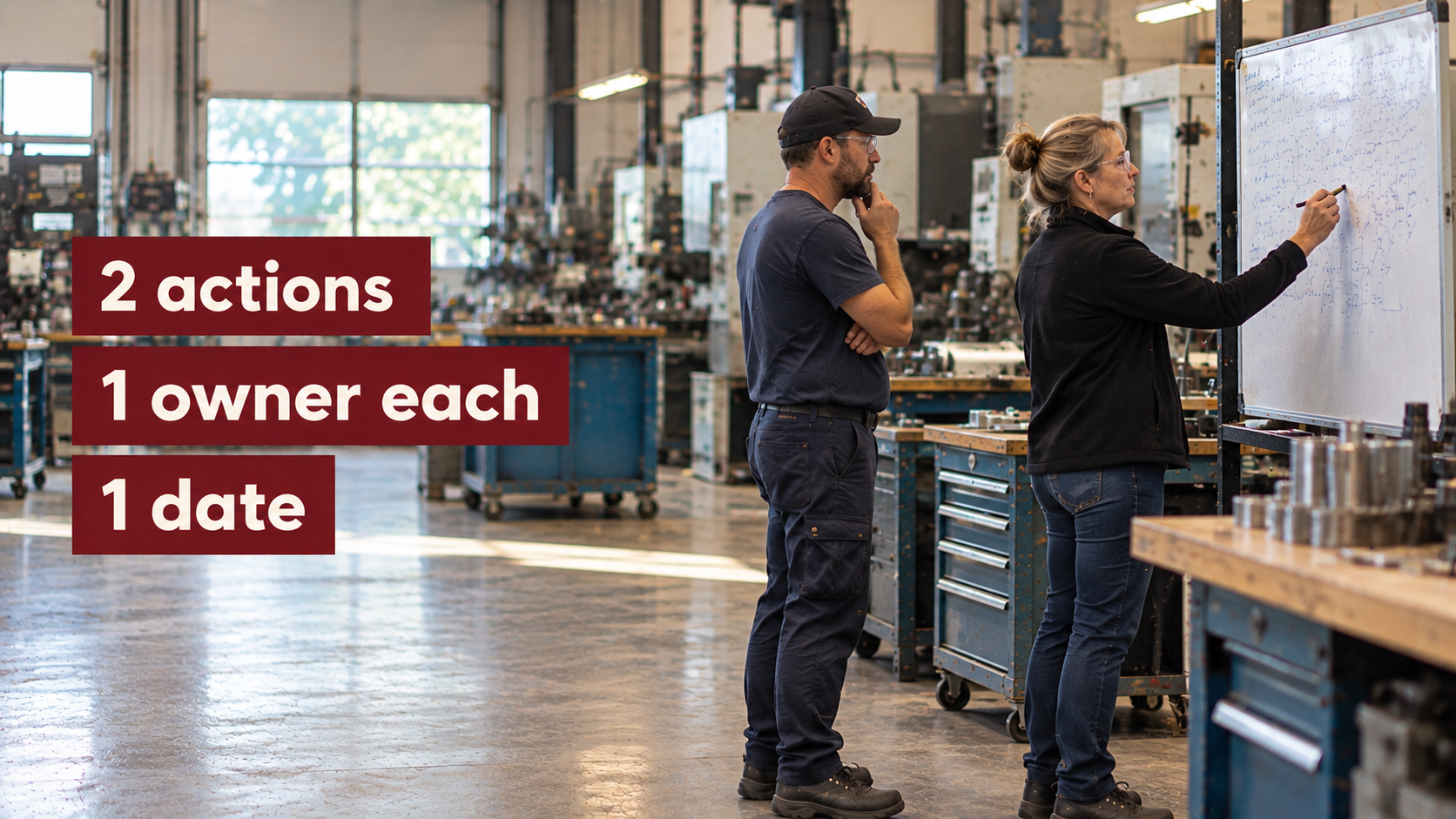
Most gemba walks fail after the walk. The visit felt good, the notes went into a drawer and nothing changed. Block 10 minutes within 24 hours and do four things.
- Read your notes and pick at most three actions. More than three and none of them gets done.
- Give each action an owner and an exact date. “Quality lead, Friday” and not “soon”.
- Put the actions on the daily board. They become visible to everyone, and the four-box whiteboard already has a place for the owner and the date.
- Tell the people you talked to. Two sentences are enough: “You told me deburr backs up on Thursdays. Here is what we are changing.” This step builds the trust that makes the next walk more honest.
On the next walk, start with the actions from the last one. Look at the same bench first. If the problem is gone, say so. If it is still there, ask what got in the way.
How often, how long and who should go
| Who | How often | How long | Focus |
|---|---|---|---|
| Owner or plant manager | Weekly, same day and time | 20 minutes, plus 10 for follow-up | Flow across the whole shop, one question per week. |
| Supervisor or shift lead | Daily | 10 minutes, built into the start of the shift | Own area: yesterday’s problems, today’s risks. |
| Quality lead | Weekly, alternating areas | 15 minutes | Where defects start, not where they are found. |
Go alone, or with one other person at most. A group of five managers walking through a 15-person shop changes how everyone behaves, and what you see is no longer the normal work. If a colleague joins, give them a different job: one person watches the flow, the other listens to the conversation.
Types of gemba walks
You will meet several names for the same basic habit. They differ by what you look at.
| Type | What you look at | Good fit when |
|---|---|---|
| Process walk | How work and material flow from start to finish. | Orders are late or output is uneven. This is the walk shown in this article. |
| Safety walk | Guards, walkways, PPE, handling of sharp or heavy items. | After an incident or near miss, or as a monthly routine. |
| Quality walk | Where defects are created, checked and handled. | Scrap or rework is rising. |
| Tiered or layered walk | The same area, visited by different levels at different frequencies. | Several supervisors and a manager need a shared routine. |
How it differs from related practices
| Practice | Main purpose | Difference from a gemba walk |
|---|---|---|
| Audit | Check the work against a standard. | An audit records gaps. A walk builds understanding. |
| Management by walking around | Be visible and approachable. | No fixed focus, route or follow-up. |
| Value stream walk | Map one product family from order to delivery. | Deeper and longer, done once or twice a year. |
| Leader standard work | A set routine of checks for a leader’s day. | The gemba walk is often one item inside it. |
Eight mistakes that make a gemba walk useless
Treating it as an inspection. If the team thinks you are looking for someone to blame, you will see a cleaned-up version of the shop. Say out loud what you are there for and ask about the process.
Fixing things on the spot. It feels helpful and it teaches people to wait for you. Note the problem, think about it, decide later and tell them.
Walking without a focus. You will notice a dozen small things and act on none. One question per walk.
Walking at a different time every week. A fixed slot builds the habit and lets the team plan around you. Skipping it because the day is busy sends the message that the walk does not matter.
Bringing a crowd. The more people with you, the less the operator says. Go alone or with one person.
Writing opinions instead of facts. “The cell looks disorganised” invites a debate. “Three carts in the aisle, 11 tools outside the shadow board” invites a fix.
Asking questions that carry a verdict. “Why do you always leave this here?” ends the conversation. “What makes this a good place for it?” opens it.
Skipping the follow-up. This is the one that kills the practice. If nothing happens after the third walk, the team stops telling you the truth.
Paper or software?
A pen and a printed sheet are enough, and you control the whole process. Many articles on this topic come from software vendors who sell apps for walk checklists and action tracking. Those tools do help once you run walks across several sites, need audit trails or track dozens of actions at once. In a single-site shop, paper plus a daily whiteboard does the job, and it lets you learn the habit before you pay for a tool that automates it. If you outgrow the paper, you will know exactly what you need the software to do.
How to tell your gemba walks are working
Do not wait for a big result. Look for four early signs:
- Operators start telling you about problems without being asked.
- The same problem stops appearing on the notes sheet.
- Most actions you open are closed by the date you set.
- The time between “someone saw it” and “someone fixed it” gets shorter.
If you want a number to track, count the actions opened and closed per month. A healthy walk produces a few of each, and the closed count follows the opened one with a short delay.
Where to go from here
If this was useful, a good next step is to pair the walk with a daily meeting at the whiteboard, so that what you see on Tuesday becomes an action on Wednesday. Our guide to the daily standup with a whiteboard shows how.
If you would like an outside view of where your operation stands before you start walking, the free Operational Excellence Assessment takes a few minutes and gives you a report across four pillars. You will also find more free printable tools on our resources page. And if you would rather have someone walk the floor with you the first few times, you can find out how we work on our services page.
Recap: How to Do a Gemba Walk in 6 Steps
A 20-minute gemba walk for a small manufacturer: pick one focus, walk the same route, watch before you talk, ask open questions, write down facts and close the loop within a week.
Total Time: 20 minutes
Step 1
Pick one focus Choose a single question for the walk, for example why orders leave late on Fridays. One focus keeps the walk short and the notes useful.
Step 2
Fix the time and the route Walk on the same day at the same time every week, following the product from where material arrives to where it ships.
Step 3
Watch for two minutes at each stop Stand where the work happens and observe before you speak. Count, time and note what you see.
Step 4
Ask open questions Ask the person doing the work what slows them down, what they work around and what they would change. Listen, and do not fix anything on the spot.
Step 5
Write down facts Record what you saw in numbers and plain words, with the time and the place. Facts can be checked next week, opinions start arguments.
Step 6
Close the loop within a week Pick at most three actions, give each an owner and a date, tell the people you spoke to what is changing, and check again on the next walk.
Frequently asked questions
What is a gemba walk in simple terms?
A gemba walk is a planned visit to the place where the work happens. You watch the process and ask the people doing the work some questions, so that decisions come from what you saw and not from a report. Gemba is the Japanese word for “the actual place”.
What is the purpose of a gemba walk?
The purpose is to understand how the work really flows and what gets in the way of the people doing it. A good walk produces a short list of facts, a few actions with owners and dates, and more trust between the person who walks and the team. Nobody is being graded.
What are the steps of a gemba walk?
This article uses six steps: pick one focus, fix the time and the route, watch for two minutes at each stop, ask open questions, write down facts, and close the loop within a week. Other guides list five to eight steps, but the idea is the same: prepare, observe, ask, record and follow up.
What are the three principles of a gemba walk?
The three principles most often quoted are go see, ask why and show respect. Go see means visiting the place where the work happens. Ask why means asking questions to understand the cause of a problem. Show respect means treating the people doing the work as the experts on it.
How often should you do a gemba walk? (Gemba walk example schedule)
Weekly for an owner or plant manager, daily for a supervisor. In the gemba walk example above, the owner walks every Tuesday at 10:30. The day and the time matter more than the length, and a walk that moves around the calendar stops happening within a few weeks.
Written by Zouhair Lahia, founder of TRI Principles Institute. Zouhair is an Operational Excellence and Lean transformation leader with over 20 years of experience across aerospace, automotive and manufacturing operations, a Lean Six Sigma Black Belt and CPIM-certified professional. He works with small and mid-size manufacturers on daily management, measurement systems and operational routines that hold up on a real shop floor. Last reviewed: October 2026.
Sources and further reading: Lean Enterprise Institute, Lean Lexicon: Gemba; Toyota Motor Corporation, Toyota Production System; OSHA, Safety Management. The shop in the worked example is an illustrative case, not a client.
1 thought on “Gemba Walk Example: What a 20-Minute Walk Looks Like in a Small Shop”